10.04.2009

Pictures from UC Berkeley walkout 9.24.09


Hi friends,

I posted some pics of the Walkout at UC Berkeley 9.24.09 on indybay.org


http://www.indybay.org/newsitems/2009/09/24/18623045.php

5.22.2009

Millionaire vigilantes, in 1930?


This clipping from the San Francisco Chronicle states - Chicago gunmen and racketeers, driven to flight by the "millionaire vigilantes," will find no haven in San Francisco, under orders issued to the entire Police Department last night by Chief Quinn.

I haven't found any other references. Could this be the inspiration for Batman?

5.17.2009

letter to the editor; ANOTHER UNINFORMED GARDEN PRACTICE

ANOTHER UNINFORMED

GARDEN PRACTICE

Editors, Daily Planet:

A few weeks ago I wrote about plans to install artificial turf at the Sankofa Academy adjacent to Bushrod Park in North Oakland, a plan with numerous problems, not the least of which is a playing surface subject to disease transmittal that has barely an eight-year manufacturers guarantee.

Today I notice another gardening debacle: lovely three-foot-tall brown ceramic flower pots filled with plant material of varying hardiness installed along Telegraph Avenue below Ashby every few blocks into North Oakland, and perhaps further to the north and south.

I have been in the business of urban landscaping for nearly 30 years, beginning with my career at the old California Street Nursery, and I can tell you that raised street planters, unless the local merchants or nearby residents adopt them, are a waste. Even if the city or merchant group responsible assigns gardeners to water them, it won’t be long before the plants are gone and the barren planters are filled with trash and cigarette butts.

I hate to sound cynical, but this well-meaning project was recently completed in an area with acres of empty and weed-filled sidewalk tree cutouts and planting strips that would better support rugged trees and hardy perennials than large clay pots.

Hank Chapot

4.06.2009

Artificial Turf in north Oakland?

Berkeley Daily Planet
3023A Shattuck Ave.
Berkeley, CA 94705


Dear Editors,

Three days before her February community meeting (on going green), Oakland City council President Jane Brunner announced she would spend 3.3 million dollars of measure WW park funds on an artificial turf soccer field to be placed on top of the blacktop play area behind the old Washington School, now Sankofa Academy. It appears from her announcement that Jane has the power over park expenditures in her North Oakland district.

Bushrod Park, perhaps the largest park in North Oakland, already has three baseball fields, a soccer field, tennis courts, outdoor basketball courts and a recreation center. In fact, nearly ninety percent of of the park is given over to organized sports. There is no dog run, no natural area, bare picnic facilities, a poor children's playground and little flat space for unorganized play. Now Brunner wants to cover, not remove, a large section of blacktop that in the winter floods onto Shattuck Avenue.

Artificial turf has become controversial across the United States for many reasons including; Friction between skin and artificial turf causes abrasions and/or burns to a much greater extent than natural grass, turf-toe is a medical condition often associated with playing on artificial turf pitches. A higher incidence of MRSA infections because pathogens are not readily broken down by natural processes and periodic disinfection is required. Artificial turf can become much hotter than natural grass when exposed to the sun, for cushioning it requires infill such as silicon sand and/or granulated rubber made from recycled car tires which may carry heavy metals. It has a short life span (10 year or less), can fail earlier and finally, artificial turf contributes to the loss of parks jobs and local funds are spent out of state for a manufactured petroleum product, and more petroleum is needed for shipping and installation.

Artificial turf is not guaranteed against accident, machinery, spiked shoes, animals, misuse, fire, flood, chemical reactions, acts of God, static or dynamic loads exceeding the manufacturers specifications at time of installation, improper or faulty subsurface preparation, failure of the subsurface after the installation including settling of the surface, and the use of dry cleaning fluids or other improper cleaning methods. Artificial turf is subject to vandalism and even if the up-front costs are said to be cheaper, there is little research on its costs versus benefits.

It is great that Councilmember Brunner is seeking to improve Bushrod Park, but there has never been a task force to analyze the wishes of the neighborhood and park users. In addition, Brunner will likely be forced to do spend additional funds for an environmental impact report on the project. Community members are invited to comment; jbrunner@oaklandnet.com (510) 238-7001


hc

3.28.2009

University of California controversies

some deltionist know-nothings at wikipedia rejected my page of UC controversies.

Here it is;

Big "C", a Cal fight song written in 1913, is appropriated by UCLA and renamed "Sons of Westwood. Copyright arguments continue until 1969 when it is discovered there was no copyright.

1936, Sir Francis Drake plate of brasse found near Point San Quentin and validated by UC Berkeley historian Herbert Eugene Bolton, a distinguished professor of California history and director of the Bancroft Library at the UC. He staked their careers on its authenticity, later found to be a hoax directed at him and made of contemporary metals.

1949-52. Regents require 'loyalty"oath, Earl Warren stands with the faculty who refuse to take oath. Over one hundred scholars depart system [1] [2] [3]

January 1954, Dr. Harold Winkler, Assistant Professor of Political Science at the University of California is cleared by Regents of charges of communism for statements made in an off campus speech.

December, 1954. Regents pay claims of five former professors involved in a loyalty-oath controversy.

The suppression off free speech in the 1960s [4] [5]

January 1967. Clark Kerr dismissed as president of the University of California by the Board of Regents without advance notice [6] [7] [8]

October 1968. Regents Refuse to Back Governor Ronald Reagan's attempt to bar Eldridge Cleaver's course on racism on the UC campus, students sit-in over issue.

April 1969 defenders of People's Park in Berkeley assaulted by police and national Guard.

1969, Professor Arthur Robert Jensen claims IQ is genetically based

July, 1970 Harry Edwards granted tenure, ending six months of controversy.

1969 Angela Davis ordered by Regents dismissed because of her Communist party membership. A judge ordered her reinstated, and her association with the university is not severed until her one-year contract expired. [9]

October 1977, The anti-affirmative action lawsuit of Regents of the University of California v. Bakke goes before Supreme Court, decided in Bakke's favor.

1981 National Institutes of Health files disciplinary action against UCLA professor Dr. Martin J. Cline who violated Federal guidelines by attempting to treat two cases of a blood disorder through genetic experimentation involving two human patients without obtaining proper permission for the work from the appropriate university committees. [10]

1992, the university is harshly criticized when details emerged about a $1 million retirement package given to then-departing president David Gardner. The system also was criticized because Gardner had promised a $181,000 ``administrative leave package to his closest aide

1992 Tim White at UC Berkeley publishes analysis of bones found at an Anasazi site in Colorado. Concludes that the bones collected include remains of 12th century cannibalism.

1994 Many UC administrators unanimously oppose changing affirmative action policy. A majority of the regents vote to abandon Affirmative action.

Regent appoint Gordon Gee president in spite of the fact that a year after Gee left the president's job at the University of Colorado to assume the helm at Ohio State University, Colorado regents learned he had bypassed the board to grant hefty bonuses of $10,000 to $13,000 to his four top lieutenants. Gee also was criticized when a chancellor he had fired received a $232,400 golden parachute and that a $75,000 bonus went to a football coach for winning the Orange Bowl. The trustees were aware of the two deals but had not known about the full amount of the chancellor's package. Both deals, however, were initially kept from the public. [11]

1996 China scholars at the University of California at Berkeley scrap idea of naming a Chinese studies center after deceased Taiwanese leader Chiang Ching-kuo. [12]

1996 Passage of Proposition 209, University can no longer look at categories like race and ethnicity in admissions.

Late 1990s failure of a much-touted merger between UCSF and Stanford hospitals.

1996 Regents held a closed- door meeting in November that university sources admit violated the state's open meeting law, one of many. [13]


Late 90s University of California pressured to offer benefits to same-sex partners. [14]

2001 reports of increased corporate influence on University of California [15]

2001 Genetically engineered goats born at [UC Davis]], genes are supposed to increase the protein content of each goat's milk, which in turn would boost the cheese output at California dairies. [16]

2002 Dr. Ray Juzaitis, the leading candidate to take charge of Lawrence Livermore National Laboratory drops out, citing the unwarranted linking of his name to the Wen Ho Lee case.

2005 Charges of mismanagement, financial scandal and security and safety issues at Los Alamos and Livermore, the national laboratories that oversee the U.S. nuclear weapons stockpile leads to shared Lab Stewardship with Bechtel, the Washington Group and BWX Technologies.

November 7, 2005 UC Provost MRC Greenwood resigns as UC investigators probed her possible involvement in improper hiring practices.

October 13, 2005 Federal lawsuit filed against UC Berkeley over religious statements found on a UC Berkeley Web site.

Passage of [[Proposition 209, University can no longer look at categories like race and ethnicity in admissions.

2002 UC Merced to destroy vernal pools, endangered habitat. [17]


July 2006, in opposition of the funding from tobacco money, the Academic Assembly endorses statement, "no unit of the University should be directed (by faculty vote or administrative decision) to refuse to process, accept, or administer a research award based on the source of the funds; and no special encumbrances should be placed on a faculty member's ability to solicit or accept awards based on the source of the funds" [18]

2003, Los Alamos National Laboratory management scandal.

2004 Concerns raise that Regent Richard Blum has a conflict of interest due to his beingmvice chairman at URS Corp., the giant defense contractor

2005 Reporting on contamination in Mexican corn crop report leads to tenure fight for Natural Resources professor Ignacio Chappela

2005 DOE puts the Los Alamos laboratory’s management contract up for competition.

2005 Tenured UC Berkeley law professor John Yoo, while serving as deputy assistant attorney general during Bush's first term, authored memos that redefined "torture" very strictly.

2006 - Allan Dershowitz attempts to stop publication by UC Press of "Beyond Chutzpah" by Norman Finkelstein

2006 Unreported executive compensation packages are reported in a series in the San Francisco Chronicle. [19]

2006 University's plan to remodel the Memorial Stadium on the east side of campus garners two lawsuits and a group of treesitters in the grove of oaks that will be cut for the remodel. Neighbors oppose campus expandsion. [20]

2006 Colombian artist Fernando Botero's Abu Ghraib paintings shown at Berkeley Art Museum. [21]

July 2006, Denice Dee Denton, chancellor at UC Santa Cruz, in scandal over nepotism and housing expenses, commits suicide in San Francisco on Gay Freedom Day. [22] [23]

2006 -07 Democratic party politicians, celebrities including actor Danny Glover honor picket lines of lowest paid workers represented by AFSCME and decline to give commencement addresses.

2007 President Dynes resigns amid compensation controversy. [24]

2007 Labs contracts given over to private firms.

2008 University officials plan on increasing out of state and foreign admissions to increase income.

2008 Governor tries to cut funding for UC Berkeley Labor Program. [25]

March 2009 Reports that University of California continues hiring high-salaried administrative talent and awarding of pay raises, promotions and perks to a dozen executives. [26]

March 2009 Lawsuit against a UC Berkeley evolution Web site rejected without comment by the U.S. Supreme Court. One page on Cal's 840-page Understanding Evolution Web site says Darwinism can be compatible with religion. The 4-year-old suit by Jeanne Caldwell said the government-funded Web site amounts to a state position on religious doctrine that violates the Constitutional separation of church and state. [27]

2009 ASUC Senator John Mogtader is recalled from Berkeley Student Government

11.06.2008

my screenplay - Bordello Politique: The Crimes of Dolly Fine

My Screenplay pitch made the top ten at the Storylink pitch-perfect contest. 


9.28.2008

Link to my recent union activities, with friends! - AFSCME

Here is a link to a story I produced and photos of a warm September 27th Saturday spent working with my union brothers and sisters of the AFSCME (American Federation of State County and Municipal Employees). we were there representing the low-wage workforce of the University of California who  are still locked in a struggle over our expired contract.

We visited the new president of UC Mark Yudof, even brought him his favorite food, PANCAKES, but he didn't show.

read the post on IndyBay...


7.23.2008

Goodbye Dona Spring

Dona spring died on Sunday the 13th of July, 2008.

she served Berkeley and represented the green party exceptionally well.
Here are some clips, the first from the Berkeley Daily Planet is the best, but many news reports failed to say she was a Green.


BERKELEY, Calif. (KCBS) -- Berkeley City Councilwoman Dona Spring has died, Dona Spring An Appreciation.
Berkeley Daily Planet, CA - Jul 14, 2008 By Becky O’Malley

berkeleydailyplanet.com/issue/2008-07-10/article/30565?headline=Dona-Spring-An-Appreciation

7.12.2008

Green party election wrap June 4, 08

I'm quoted in this press release from the Green Party of CA after the June primary.

"Low voter turnout, expensive advertising, out of control independent expenditure committees, special interest pandering and only two parties in competition. That is the state of elections in California these days," said Hank Chapot, a Green party member and union organizer.

"Without public financing, proportional representation and free media, we will remain stuck in the dysfunctional system and never get to peace, environmental justice and small d democracy," he lamented.

6.26.2008

The history of tree sitting, since 1930

Tree-Sitting, Since 1930

By Hank Chapot

Thursday June 26, 2008


The Memorial Stadium oak grove standoff at the University of California is a dangerous and dramatic business, but tree sitting has a more prosaic origin. In the summer of 1930, when “endurance marathons” were the rage, schoolboys and girls across the country became tree-sitters for glory and prizes and a chance to get their picture in the paper.

In the first summer of the Great Depression, bicycle marathons, pole-sitting, even mustache contests were popular diversions. Very young kids across the nation took up the challenge, climbed up high in a backyard tree and built some great tree-houses. Newspapers and radio stations increased readership and announced prizes; bicycles, a wristwatch, savings bonds, a job. Local merchants supplied shoes and radios and tacked advertisements to the tree trunks and fences. Money boxes nailed to the trees jingled with coins dropped by the growing crowds. Feature stories followed: twins sitting, a mother of three, a boy scout and even a housewife with a bathing tub were going for the record in neighborhood trees. The story exploded; children across America took to the trees.

From Jersey to Georgia, Bremerton to Santa Barbara, the “tree sitting epidemic” spread. Sitters went on radio, took baths and had haircuts and doctor’s visits aloft. Radio stations updated hourly and interviewed 4-year-olds on the resupply teams. To the consternation of parents and property owners, the crowds increased by the week.

Twelve-year-old E. B. Landre of 5866 Shafter Ave., Oakland (gone beneath Highway 24) joined the challenge, completing 360 hours as Oakland’s “Human Apple” in his mother’s apple tree, inspiring a dozen imitators across the East Bay. Neighbors thronged to the Shafter Avenue house, and his mother was happy to know where her son was for once. Before alighting to join child star Billy Page on the NBC radio network, “Eebee” (his nickname) was assured of his standing, for the moment, as Bay Area champion. He then got ready for a new school year.

Some writers recommended cutting all trees. Will Rogers suggested they climb the giants in Yosemite.

One kid relocated to a new tree and was carried on a severed branch. Another was attacked with slingshots and gave up, one lit his tent on fire, others were chased from the trees by lightning, summer heat and rain. One was visited by a skunk, and some got homesick, like Lisa Simpson.

A Florida newsmen’s association passed a resolution against wasting more ink on tree sitters unless and until they fall and break their necks, with a view toward protecting children from reverting to their “ape-like tendencies.” The Bremerton tree sit lasted 518 hours, a Santa Rosa youth went 1,305 and one in southern California went 1,320 hours.

A year later, consensus seems to support Leslie “Rhubarb” Davis’ record of 107 days in Gibson City, Ill. When asked why he did it, Rhubarb replied, “I didn’t have to work the whole time I was up there.”

As the publicity spread, law-and-order citizens, juvenile courts, child welfare societies and police combined forces to end the nonsense. Cities declared public parks off-limits. A few sheriffs climbed ladders and grabbed kids by the belt or around the neck.

In late August, coverage ended abruptly when four hours shy of his goal of 500, 16-year-old Nelson McIntosh of Lexington, Ken., fell to his death while pulling up his lunch. Competitors quickly descended and requested Nelson be declared state champion. The fun quickly bled from the game. Before long, “tree sitting” and the marathon craze become fodder for propagandists as proof America had gone soft.

There is more. In Woodstock, Virginia, in 1935, Mrs. Lorraine F. Brown, denying she had a pistol or a pitchfork in hand, perched among the branches of her maple tree and secured a court injunction to save the tree in front of her house from street widening. In 1937, a London play called Climbing satirized a youth who climbed a tree as the first step in flying. In 1939, Mr. Bink sat in a tree in the movie On Borrowed Time. A one-act play called Sittin’, about a Guinness World’s Record, played at the Ensemble Studio Theater in 1980. (By the way, the Guinness website does not cover tree sitting). My favorite tree sitter is the uncle in Fellini’s 1973 film Amarcord.

Berkeley’s own Malvina Reynolds wrote a song after housewife Lois Knill in 1965 tried to stop the destruction of a row of pines on adjacent property in her wealthy Harbor Point subdivision on Tiburon. Mrs. Knill did not exactly sit in a tree, she took up residence on top of a stump, threatened the developer, whom she called a pig, talking about a .44. Originally titled, “The Lady and the Tree,” Reynolds’ song tells the story of a woman who “cried and cursed for the murder of a tree.”

Tree sitting has a single purpose now, and tree defense rages across the planet, there have been deaths, and every loss is permanent. But, take heart: young people not much older than Eebee are still climbing trees. As witnesses to the drama at Memorial Stadium, take a moment to ponder the young folk of 1930, children my father’s age, who jumped at the chance to spend some warm summer nights sleeping in a tree.

published: Berkeley Daily Planet 6.26.08
Hank

6.12.2008

UC bereft of commencement speakers

FOR IMMEDIATE RELEASE
Contact: Lakesha Harrison, President: 310-877-6878
Maricruz Cecena, Graduating Senior: 310-429-2207

Retired General Wesley Clark Latest in a Series of Cancellations by UCLA Graduation Speakers

6.12.08

Clark joins Former President Bill Clinton, and Congressmembers Waxman and Solis to refuse to cross the picket line of 20,000 UC workers

California – Retired General Wesley Clark is the latest of a growing group of speakers to cancel their scheduled appearance at UCLA’s commencement ceremonies this weekend unless 20,000 UC workers receive of a fair contract. Former President Bill Clinton confirmed his cancellation on Tuesday and was joined by Congresswoman Hilda Solis and Congressman Henry Waxman who were also scheduled at UCLA this weekend. Students, workers and community supporters are planning to picket at commencement ceremonies across the state this weekend.

"I am disappointed that I will not be able to be a commencement speaker, but I won't cross the picket line. The students who are graduating, along with their parents who support them should be congratulated on their achievement. My hope is this dispute will come to a resolution very soon."
– Retired General Wesley Clark

"Until the University of California and the 20,000 patient care and service workers resolve their dispute, I won’t be able to speak at the commencement ceremony for the U.C.L.A. School of Public Health. I will not cross the picket line and hope this is resolved as quickly as possible."
– Congressman Henry Waxman

The 20,000 patient care and service workers do everything from assisting in surgeries to cleaning dorm rooms in the University of California’s ten campus/five hospital system. They have been negotiating for a fair contract since August, 2007.

Graduations at other UC campuses have also been affected by this show of solidarity with UC workers, including Speaker Emeritus of the California Assembly Fabian Núñez’s cancellation on Wednesday at UC Davis. Robert Kennedy Jr., Assemblyman John Laird, Assemblywoman Fiona Ma, Angela Davis and many notable professors have also pledged to cancel unless the contract is settled. This represents speakers at nearly all UC campuses where graduations are scheduled.

At issue are UC wages, which are dramatically behind other hospitals and California’s community colleges where workers are paid an average of 25% higher for the same work. Patient care workers are concerned this is contributing to high-turnover, staffing shortages, and over-reliance on temps which can affect patient care as extra time is needed to train the constant flow of new staff.

For service workers, wages are as low as $10 an hour, and 96% of UC service workers are income eligible for at least one of the following public assistance programs: food stamps, WIC, public housing subsidies, and reduced lunch. Many work 2-3 jobs to meet their families’ basic needs.


The American Federation of State, County, and Municipal Employees (AFSCME) Local 3299, AFL-CIO represents
20,000 patient care and service workers at UC including licensed vocational nurses, medical techs and assistants,
respiratory therapists, custodians, cafeteria workers, and security officers.
2201 Broadway Ave, Suite 315
Oakland, CA 94612, (510) 844-1160, media@afscme3299.org
###

3.29.2008

Man in the Moon kite


I've saved this kite since I was a teen age kite flyer. We used to go up on "Moron Hill" and smash our kites into each other, kind of a kite dogfight.

2.01.2008

UC, the Wal-Mart of higher education?

published in the Berkeley Daily Planet February 1, 2008


If you love the University of California, you may be interested in a study released Jan. 15 by the Center for Labor and Community Research, titled, “Failing California’s Communities: how UC’s low wages affect surrounding communities.”

For those who pay attention to UC’s labor issues, the story is depressingly familiar. This study of zip codes and census data for roughly 20,000 low paid UC service and patient care employees at ten campuses and five hospitals asked the question; if UC paid market-rate wages, what would be the economic impact, or “multiplier effect,” and where would it show? It was produced with help from AFSCME local 3299.

The conclusions were clear, UC’s lowest paid workers are concentrated in low income communities most in need of economic improvement and UC is failing those communities by paying wages significantly below other colleges and hospitals in California (25 percent below overall). Comparisons were made to wages at regional hospitals and large community colleges. Citing a 2005 study by the National Economic Development and Law Center, one-third of UC’s 124,000 employees do not earn sufficient wages to pay for food, rent and other basic necessities and many are eligible for public assistance. Nearly half of UC patient care and service workers live in neighborhoods with a poverty rate 50 percent higher than those surrounding the campuses. In the Bay Area, the percentage is probably higher.

That study recognized that compensation practices of large employers affect entire communities. CLCR researchers note that as one of the largest employers in the state, if UC paid prevailing wages, it would have significant direct economic impact on struggling communities, including Oakland and Richmond, Inglewood and Hawthorne, plus 55 other working class communities near the UC system, where incomes run 15 percent lower than average. CLCR researchers conclude that, “the economic impact of UC matching prevailing wages is estimated to add $147 million in spending on local goods and services in those communities, create nearly nine hundred new jobs, add $9 million in state and local taxes and contribute $23 million in local business earnings.” Obviously, if UC were to provide market-rate wages, the social returns in low and moderate income communities would be far greater than any increase in sales of luxury goods in upscale districts adjacent to UC campuses from payoffs and perks lavished on top management.

Old-timers tell me UC used to say, “it is a privilege to work for the greatest university in the world, and because of our interest in public service and the egalitarian mission of the university, you will gladly accept a little less.”

More recently they said, “the economy is bad, we have to raise fees, tuition, health care costs, and no, no equity increases this year.” Seems every year, good or bad, UC’s primary customers, students, classroom educators and hospital patients take the hit.

This year the mantra is, “Arnold won’t give us the money, $14B deficit you know.” But the state budget slice for service workers at UC is just 8.6 percent, the rest comes from hospital revenues, the feds and non-governmental funding such as food services and parking. While tuition costs explode, students fees, the ultimate battering ram of UC’s excuses, provide barely 1 percent of service costs.

And I’m talking about unionized workers here, usually the most stable members of working class communities, whose wages UC is keeping down. People end up taking second jobs, putting their teen-aged children into the workforce and even collecting cans during breaks for a little extra cash.

Sources in current contract negotiations say the university has acknowledged that it is not about money, rather, they claim it would be “fiscally irresponsible” to raise workers pay to prevailing wage. That from a public entity with 22 billion dollars in net assets(assets minus expenses), up 18 percent in the last two years, a university system that is the largest recipient of Federal R&D funding in the nation, $4 billion last year alone. Current Berkeley Chancellor Robert Birgeneau recently cited low turnover at the bottom as justification for underpaying workers, and it is true that we need our jobs and UC can be a good place to work. However, we have less employment mobility than UC’s elite and are therefore ripe for exploitation.

Readers will be unsurprised that labor contracts within the UC system are in flux. One of the largest employers in every jurisdiction where it resides, UC seems determined to continue depressing wages, in contradiction of its stated ideals.

From the study’s conclusion; “What is at stake is the economic future of West Sacramento, San Pablo, Watsonville, El Cajon, East Oakland and other poor communities that would greatly benefit if UC made a greater economic investment in California’s communities.”

A PDF version of the study “Failing California’s Communities: how UC’s low wages affect surrounding communities” is at www.clcr.org/index.php.

letter on Campus workers, UC Berkeley

CAMPUS WORKERS

Editors, Daily Planet:

As Richard Brenneman highlights events and issues at UC Berkeley in 2007 (BDP v.9, #77) he omitted some good stuff concerning workers on campus. Local 3299 of AFSCME chalked up important achievements this past year, we won a pay equity struggle to bring the lowest paid food services and custodial pay up from poverty wages a dollar or so and established protection of workplace language rights and restitution of faulty pension calculations for employees at the International House.

Numerous commencement speakers honored our request to stay away from graduation when informed of the equity dispute, and some Democrat candidates for president refused to come on campus. We would like to thank them for their solidarity.

In other news, UAW-represented academic student employees won wage and contract improvements while the coalition of UC labor unions—including UPTE Professional and Technical Employees, CUE clericals, UC-AFT lecturers and librarians, UAW Academic student employees, AFSCME service workers and patient care employees and CNA—successfully blocked pension-withholding increases for all 10 campuses, took up the struggle of toxic pollution at the Richmond field station and are working across boundaries to help the unions that are currently in or soon entering in to contract negotiations.

Hank Chapot, Oakland

UCB central campus gardener

9.22.2007

Chancellor's comments, UC Stadium project

Chancellor's comments, UC Stadium project,

MAXWELL FIELD GARAGE
7.10.2007
Editors, Daily Planet:

Don’t be fooled by the recent UC offer to downsize the garage under the Maxwell Field (Daily Planet, July 3). The offer came on the heels of Chancellor Birgeneau’s annual meeting with the Staff Assembly Committee at which, in his opening remarks, he mused about why the city would waste all that money (on a lawsuit) because, as he stated in typical UC arrogance, “the sports facility is only delayed. It will be built.” Ignoring the issues, Birgeneau dismissed critics by claiming there is only one reason for the project; “to get our athletes out of an unsafe structure.”

Appealing to our sympathies, he used “safety” to obfuscate the real issues; traffic, night-light pollution, the views from Strawberry Canyon, the reduced landscape, the trees. Besides, I work in another of UC’s “unsafe structures,” the Edwards Track, built of concrete pillars that may fall in the next quake, but I guess a bunch of gardeners are a lower priority than a bunch of marketable footballers.

Hank Chapot

Bikes in Berkeley CA - letter to Editor

8.10.2007
Berkeley Daily Planet

RULES OF THE ROAD

Editors, Daily Planet:

I understand Michelle Lerager’s consternation over Berkeley police actions toward bicyclists (Aug. 7). It is strange that they would crack down on erratic cycling when there are thousands of irresponsible, dangerous and selfish automobile drivers on our streets.

The bicycle is only a threat or traffic nuisance if you drive a car. Few pedestrians will complain about bicycles, and those only because some cyclists are so intimidated by cars that they ride on sidewalks, an activity cycling activists condemn. The truth is, most bicyclists have drivers licenses, most know how to drive a car and are aware of the rules of the road.

In fact, bicycle advocates in the late 1890s went to court repeatedly to gain recognition as vehicles. Even the Supreme Court decided that yes, bicycles are entitled to the road, and are subject to all rules therein. So, why do we ride so crazily? Well, first, we aren’t given our rights by the steel and glass monsters we share the road with, and second, we have this little problem of maintaining our forward momentum.

I demand cars give up road space to everyone else, and if I could have one exception to the rules of the road governing bicycles, I would fix the state vehicle code and solve Michelle Lerager’s problem by passing legislation that says STOP equals YIELD for bicycles.

Hank Chapot

Oakland

9.15.2007

letter to editor BERKELEYAN concerning Chancellor's statements

BERKELEYAN

http://www.berkeley.edu/news/berkeleyan/2007/08/22_letter.shtml

Letter to the Editor

22 August 2007

Your front-page report on the “chancellor’s chat” sponsored by the Berkeley Staff Assembly (July 12) repeated remarks Chancellor Birgeneau made concerning the recently concluded wage settlement between UC’s lowest-paid workers and the Office of the President (UCOP).

Birgeneau said that he had been “quite vocal” in his opposition to the settlement and that he’d made his opinion known to UCOP. American Federation of State, County and Municipal Employees (AFSCME) members in the audience found it discomfiting that Birgeneau expressed his disagreement with the settlement before a largely non-unionized audience.

In writing that the settlement included special raises for custodians, the Berkeleyan reinforced the chancellor’s division of staff from unionized workers. In saying that he “didn’t think it was fair” that one group of workers got the pay hikes while others in similar ranges did not, you and the chancellor both ignored the so-called “compensation crisis” at the top of the system and the fact that Birgeneau could yet join efforts to bring the entire workforce up to market.

Unmentioned in the Berkeleyan writeup, but of concern to our members, the chancellor said that 60 percent of the cost of the raises would be borne by students (except those on financial aid) in the form of increased housing fees, even though, in an Oct. 12, 2006, letter to UC President Robert Dynes, state legislators Don Perata and Fabian Núñez stated that the Legislature had set aside “additional funds [AFSCME estimates the amount as $9 million] to address pay equity for U.C. custodians and groundskeepers at Berkeley, Irvine, Santa Barbara, and Santa Cruz.” Why the discrepancy, only the chancellor knows.

That AFSCME successfully lifted the poverty wages of staffers who keep the campus safe, clean, and well-fed is something to celebrate. We at AFSCME are sorry the chancellor does not agree.

Hank Chapot
UC Berkeley gardener/AFSCME steward

Carbon Credits? Not!

Here is a link to an article about Carbon Credits from the Monthly, an East Bay (California) magazine. I am interviewed as someone opposed.

http://www.themonthly.com/feature-08-07.html

9.06.2006

Boell Foundation Green Party poster archives

Link to the Boell Foundation Green Party poster archives

Click title

9.02.2006

old photo

John Chapot home page (my Bro)

My brother John has a webpage, click his name for link


greens without borders

worst case scenario: Global warming=universal destruction

Let's talk worst case scenario: Global warming=universal destruction
Scientist have come to the conclusion that yes, global warming is real and, yes, we need to act. However, science, being conservative, sends much of its predictions into the far future and limits scenarios to forseeable problems such as; three degrees of warming in a hundred years, a few feet of sea level rise in fifty, bigger storms, crop damage, population displacement, glacier retreat, etcetera.

Nobody wants to discuss the possible scenario that it is too late to prevent the complete elimination of life on earth...

The atmosphere of terrestrial planets is rich in heavy gases and gaseous combinations, CO2, Oxygen, Nitrogen and trace elements like Ozone and Argon. The atmosphere of gaseous planets is more problematic. Any available water is evaporated into the atmosphere and all the byproducts (perhaps oif previous ecosystems), such as methane and nitrogen are volitized into a soup of indigestible products hugging the surface and killing off any possibility of life(as we know it). Most other planets could never have supported life.

Sad but true. So I am asking, what if the planet Earth, lucky to find itself in a gentle zone, (called Goldilocks by planetary scientists "not to hot, not too cold", and I might add, not too filthy), is in bigger trouble than any one has contemplated?

What if the project of human industrialization has, in less than two hundred years, converted the prevailing atmosphere of the planet Earth into a soup of the byproducts of fossil fuel imolation and set the planet on an inexorable course towards a methane + nitrogen atmosphere that cannot, and will never again, sustain a form of life any ways near the highly structured human species, let alone frogs and butterflies?

Posted by Hank Chapot at May 13, 2006 06:29 PM

9.01.2006

GREENS DEFEND CRITICAL MASS

GREENS DEFEND CRITICAL MASS AND BICYCLES AGAINST MASS ARRESTS

WASHINGTON, D.C. -- Green leaders spoke out against efforts by law enforcement to target Critical Mass, defending cyclists' right to assemble.

Critical Mass, which holds mass bicycle rides to celebrate the bicycle as a healthy alternative to the automobile, has been the target of recent mass arrests and confiscation of bicycles.


"Police could easily allow Critical Mass rides to proceed without incident, instead of disrupting them and arresting riders," said Henry Lawrence, past President of the Florida Bicycle Association and Florida Green Party candidate for Bay County Commissioner in 2004. "Cities should make every attempt to accommodate bikes. Cities face increasing traffic demands, the effects of car exhaust such as asthma epidemics among children, and global warming. Bicycles represent one of the best hopes for clean urban transportation."

At least 37 Critical Mass participants were arrested in New York City on Friday, March 25; riders claim frequent harassment by police and city officials in New York and other cities.

"If bikers need a permit in order to gather in a public space, why isn't a similar permit required for cars?", asked Hank Chapot, archivist for the Green Party of California who has participated in Critical Mass rides in San Francisco, Berkeley, and London. "The permit requirement allows arbitrary arrest of bicyclists, including those who aren't involved in Critical Mass events but happen to be nearby."

Greens called the suppression of Critical Mass and a recent New York City lawsuit to gag Times Up, a nonprofit organization that has mentored Critical Mass, part of a larger campaign to criminalize protest.

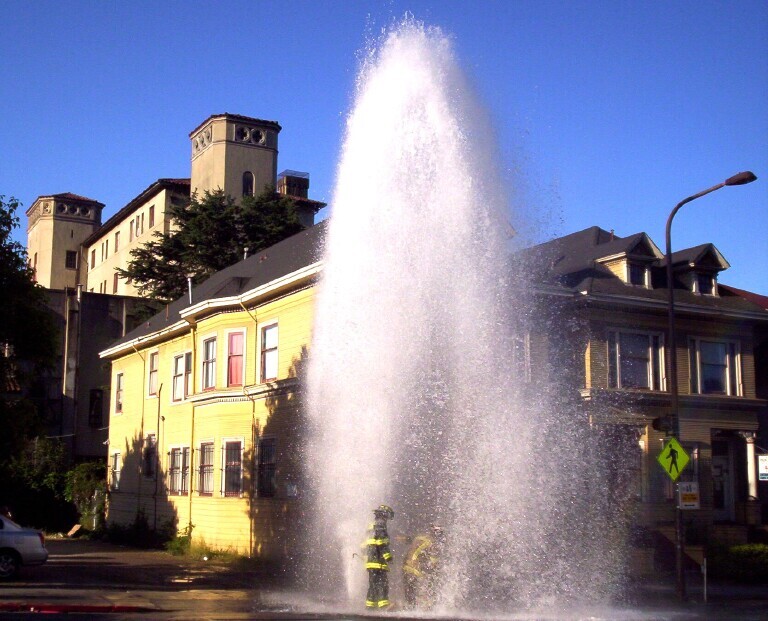
Photo of broken hydrant, Berkeley CA


Bancroft Avenue Waterworks
A Berkeley garbage truck hit a fire hydrant on Bancroft Avenue below Dana Steet around 7 a.m. Tuesday creating a huge geyser of water that took about 20 minutes to contain.

Photograph by Hank Chapot.

Save the old San Francisco-Oakland Bay Bridge!

BAY BRIDGE

Editors, Daily Planet:

Now that the bids for the final section of the new eastern span of the Bay Bridge are being considered, perhaps we should start a campaign to preserve the existing eastern span, for logistic as well as historical reasons. It would be a backup bridge in the event the new one is a failure and it would be a nice place to walk or ride bicycles and picnic. Saving the old bridge would be a nice homage to the builders of the 1930s and a prudent effort perhaps, considering the problems we’ve had building a new one.

Hank Chapot

Oakland

Freedom of Assembly? Not!

FREEDOM OF ASSEMBLY

Editors, Daily Planet:

I agree with J. Douglas Allen-Taylor that it is bad public policy for Oakland police and the CHP to harass drivers in east Oakland just because the sideshow thing is out of hand, but how far does his freedom of assembly argument go?

On Saturday night, Oct. 1, we had a little activity of the unneighborly kind on my block of 58th Street near Shattuck, that spoke volumes about the lack of space for Oakland’s teenagers to hang out and to the inability or unwillingness of the Oakland Housing Authority to supervise its property, which happens to be across the street from my (rented) house. Perhaps I am being overly sensitive, but this is the site of two border dispute murders within five weeks in the summer of 2003.

There were no deaths this time but lots of broken bottles, a few car windows smashed and a lot of police time wasted because a 13-year-old’s birthday party, perhaps turned into a flash crowd by the ubiquitous cell phone, spread out into the OHA parking lot, then the street with cars blocking the street, fighting, drinking, loud music and waves of youths running away from the eventual swarm of Oakland police.

Adding insult to injury, my call to the housing authority police dispatcher was answered by, “we only have one officer tonight, and he’s busy.” (This on a warm Saturday night for an organization with more than a thousand units). I waited on hold for 10 minutes, hung up and called back, very angry this time, and finally got her supervisor, a corporal named Jerry Williams. He said “I only have one officer and what am I supposed to do about it?” Continuing, he said, “What can one guy do against a crowd?”

While many homeowners on this block want the place shut down, even considering a nuisance lawsuit against the housing authority in the wake of the murders, I am one of the few who’ve supported keeping the place open because people need housing. But now I have realized that the OHA can’t control its own property and can’t keep the peace on 58th Street.

How would J. Douglas Allen-Taylor answer this freedom of assembly issue?

Hank Chapot

Wheelchairs in Berkeley?

Editors, Daily Planet:

The current discussion about access for wheelchair riders is another reason Berkeley is such a great city. The fact that sidewalks are in worse shape than many roadways suggests nirvana has yet to be achieved. But we limit ourselves by focusing solely on wheelchairs.

Cities across the U.S., from Arizona to Maine and now Berkeley, are struggling to assimilate all kinds of new personal transportation devices. Local governments are confronted with retirement community residents, fully capable disabled, skatepunks, golfers, cyclists, eco-activists and users of slow, non-internal combustion transport machines demanding a fair share of the road for urban golf carts, electric and gas-powered scooters, EVs, three-wheeled bicycles, bikes with trailers, small and large motorcycles, mopeds, skateboards, roller skates, those wheelie things with the handle, children on hotwheels, rickshaws, pedicabs and even the ill-fated Segway riding machine. And it’s obvious they can’t all be on the sidewalk.

American tradition and court rulings have affirmed the right to travel. City streets have never been the sole province of automobiles. Public roads serve multiple purposes beside transit; unloading groceries, pouring concrete, walking your dog, riding your wheelchair. Those who do not own a motorized vehicle retain

the civil right to mobility. In addition, legal precedent affirms the right to go slow on all public roads except those with controlled access or minimum speed limits like freeways. Municipalities are only allowed to enforce traffic requirements such as periodic yields. Many of these laws come from rural areas where farm machinery and horses maintain the right to the road and include legal precedent from Amish country.

Unfortunately, some localities dealing with electric and human-powered vehicles try to fashion laws giving slow vehicles a “little access,” amounting to second class citizenship, even requiring counterintuitive traffic gestures confusing to car drivers. But special rules setting apart various classes of vehicles are not the solution. Accident statistics prove what traffic engineers and bicycle scientists say. Full integration of bicycles in traffic is not only necessary for the cyclist’s right to travel, but is safer than segregation. Adding other classes of small personal vehicles will have similar minimal impacts on traffic if automobile users decide to share the road.

Of necessity and inkling, wheelchair users are social pioneers, but we will all benefit from emerging forms of personal transportation and must support them, and we all must take cues from bicyclists who have struggled for access for more than one hundred years. Some day in Berkeley’s future is a city crisscrossed with trees and multi-purpose public spaces where automobile users are expected to yield to little children, EVs and Wheelchairs. The automobile will have it’s place, but so will the rest of us.

Hank Chapot

Oakland

Bicycle commuter, employed in Berkeley

Orville Schell is anti-labor, and really stupid

"An Inconvenient Tactic," Water Cooler, 6/7

The advent of elite journalism
Orville Schell's intemperate remarks about my labor union, AFSCME, display his complete lack of understanding of the power dynamics in the struggle between low-income workers and UC. Quoted in your paper that he, "find[s] it pretty unconstructive of them to be canceling graduations and things like that. I really don't understand." He vows never to contact the union again. "Nor would I think most people at the university would choose to speak to [AFSCME organizer Debra] Grabelle." I hope Schell isn't serious; I presume he likes his toilets clean and his trash hauled away.

By these comments, he not only insults the lowest-paid workers at UC, but also exposes one of the prime reasons journalism is in trouble today. Until perhaps the 1970s, most journalists were working stiffs; many weren't college graduates. Even well-known reporters came from small and medium markets. They understood their job was to watchdog the rich and powerful. To cover the abuses of power. By professionalizing journalism at elite schools, people like Schell have reinforced the disconnect of journalism from its blue-collar roots. His students come to believe they are part of the power structure and not the working class. With the advent of elite journalism, they have joined the rich and the powerful and are therefore inhibited from covering their own class, and as displayed by Schell's snooty comments, have lost all compassion with the working poor, and, in his words, "do not understand" the very real struggle over wages at his university.
Hank Chapot, UC gardener, Oakland

similarities between the sideshows and Critical Mass

SIMILARITIES

Editors, Daily Planet:

In the debate over Oakland’s sideshows, has anyone recognized the similarities between the sideshow phenomena and Critical Mass? Both events involve marginalized people using whatever means are at hand to retake some public space, have fun, meet new people and enjoy the good weather. It may seem a stretch to compare African-American youth with no space in the entire city of Oakland to poor bicyclists squeezed out and hated by motorists, but the similarities are there.

Sideshows and Critical Mass are both leaderless but self-organizing, spontaneous but predictable, fun, alt-community events with political overtones that threaten to keep youthful rebellion alive. Both phenomena are confusing and frightening to the uninitiated and both make demands for breathing room in the public arena.

The other similarity is the way the media, the police and city are reacting to sideshows; very much like the way the San Francisco mayor and police behaved when confronted with Critical Mass. First, they ignored us, then they tried to control us, then for a while they facilitated the ride, then they tried to fight us by cracking heads, impounding bikes and making mass arrests, then they got over themselves and went back to helping the ride pass through unmolested, like any other civic nuisance that mucks up public streets on any given day. And though it still goes on every month in a town near you, unless you’ve been stuck in it, you haven’t heard much about Critical Mass in years, because the shock value has waned and the media has moved on to the latest menace du jour like sideshows and terrorist preschoolers.

Perhaps we should think outside the mayor’s box.

Hank Chapot

TELEGRAPH NEGLECTED

TELEGRAPH NEGLECTED

Editors, Daily Planet:

Isn’t it great to read the words of our so-called leaders discussing the demise of Andy Ross’ bookstore on upper Telegraph Avenue? How happy I am to see that our Chamber of Commerce, our mayor and anybody but Kriss Worthington has so much faith in the urban commercial zone called “Telegraph Avenue” that they would state their profound support for such an important urban commercial zone?

Andy Ross states, “the city has played a negative role, having ignored Telegraph Avenue. The city has decided to treat downtown as an economic opportunity and to treat Telegraph as a crime problem and not as an economic opportunity.”

Mayor Tom Bates says he suspects that “older” (read post-yuppie prigs) book buyers feel more at ease shopping at Cody’s store on trendy Fourth Street. “It’s more upscale and more comfortable,” Bates said. “Telegraph Avenue is a great place, but some people (read upscale gentrifiers) don’t want to go there.” Yeah, yuppie elders and Bates supporters hate young, indigent people.

Community Development Project Coordinator Dave Fogarty says “There are migratory youth and drug dealing,” noting that people “are acting out obnoxiously,” shouting and sitting on the sidewalk with their feet sticking out. “People find it unpleasant.”

I’ll bet the remaining merchants on Telegraph are really happy with the public face Mayor Bates, who wants to be reelected, and the supposed supporters, have given to Telegraph avenue’s image.

Hank Chapot

http://www.berkeleydailyplanet.com/article.cfm?archiveDate=05-16-06&storyID=24149

TRAFFIC ANARCHY?

TRAFFIC ANARCHY?

http://www.berkeleydailyplanet.com/article.cfm?archiveDate=06-07-05&storyID=21568


Editors, Daily Planet:

With all the talk about traffic in Berkeley—Marin Avenue, the circles, the buses and all—it is time to add another concept to the mix and really get people going. How will our city streets function if we remove all traffic signage, road striping and stoplights? Is Berkeley ready for the complete removal of the reminders of the rules everyone should know anyway?

A recent article in the Toronto Star described these “Naked Streets.” The idea, gaining popularity in Europe and pretty much the rule in less developed countries, is to reduce the sense of ownership vehicle drivers carry and equalize users of roads by forcing more eye contact and negotiation. Experiments in a handful of European cities with signage removal are ongoing, but the preliminary results are very encouraging. Dutch, German and Danish planners are having good results with the test, even in crowded inner-city intersections. Some districts in London will soon begin trying out the idea.

On naked streets, drivers slow down a bit, check the intersections on approach and make eye contact with other drivers, pedestrians and bicyclists, instead of blindly driving wherever the signs say they can. Removal of signs and striping encourages drivers to focus not on lights and signage but on what’s happening around them, and to adjust their driving style accordingly.

In the U.S., we go for extreme regulation rather than common sense and sharing. Americans will shudder with thoughts of anarchy on the roadway when they hear of naked streets, but when all signage, striping and lights are removed the rules of the road still apply. Naked streets might reverse our authoritarian impulses just a little. Oh, maybe we’ll keep the street signs.

Hank Chapot

Free Beer in Berkeley?

FREE BEER

Editors, Daily Planet:

Zelda Bronstein’s expose of free beer at the Berkeley homecoming game is only the tip of a huge iceberg. The amount of alcohol consumed and the problem of driving under the influence around home game tailgate parties all over campus would be a scandal if it occurred in any other jurisdiction.

As an employee of the campus grounds department, I have once or twice been required to pick up the tons of tailgate party trash, including empty cases of wine, beer and hard liquor bottles unceremoniously left behind by alumni and boosters who have a funny way of showing their love for UC; drinking and partying and trashing the place, then using the streets and freeways to drive home. And I’m not talking about fraternities.

If the Berkeley citizenry is troubled by the Honda dealership giving away free beer, imagine what they’d think of all the drunk drivers leaving the football games. And if the police are really in search of evil-doers, perhaps they’d stop harassing gutter-punks on Telegraph for a moment and set up checkpoints on University Avenue and do some breath testing.

But that wouldn’t work because so many of those drunk drivers are being hit up for funds to build the new stadium.

Hank Chapot

http://www.berkeleydailyplanet.com/article.cfm?archiveDate=10-14-05&storyID=22526

Drive better, save money

GAS PRICES

Editors, Daily Planet:

In the face of high gas prices, we should discuss the simple fact that if every driver stays off the road 10 percent of his or her time, others will get to their destination faster and therefore save money in gas. Few things are more wasteful than sitting in traffic.

Hank Chapot

http://www.berkeleydailyplanet.com/article.cfm?archiveDate=05-09-06&storyID=24089

Your own, personal, carbon credits

Commentary: Berkeley Daily Planet

Your Own Personal Carbon Credits
By Hank Chapot (09-01-06)

http://www.berkeleydailyplanet.com/article.cfm?issue=09-01-06&storyID=24990

Local papers are reporting that Burning Man is addressing its energy usage in a scheme called Cooling Man (coolingman.org) wherein Burners can pay for their energy usage by purchasing “carbon offsets” and reduce the festival’s global warming impacts. A fine idea, but the claim that participants will “offset” their global warming impact “the same way as a large corporations do” by investing in clean energy projects is not exactly correct. It hides the larger problem of current free-market answers to global warming.

While Burners are being asked to pay for their pollution, today’s increasingly internationalized carbon trading plans reward large corporate polluters with “carbon credits” based on their historical pollution levels, usually in tons, which they can then trade on the open market to other corporate polluters. Trading pollution credits in a market-based system includes the buying of so-called carbon sinks that are supposed to “sequester” CO2 and supporting no-greenhouse gas energy production. In the US, there is even an “acid rain” trading system for sulfur dioxide emissions.

Unfortunately, this plan financially compensates heavy polluters and only redistributes pollution by giving them credit for polluting in the first place.

Every American, as citizens of the country that spews more than a third the world’s pollution, is more or less responsible for a portion of the pollution our country produces. So, if we think about pollution trading in a more democratic way, why can’t each and every American, from the president on down to the newborn infant, be given a piece of the pollution market, just like the polluting corporations? We could each take responsibility for our own environmental footprint. By choice or by necessity we would be rewarded for living a low energy lifestyle.

I walk a lot and ride a bike to work. I haven’t owned a car in three years and haven’t flown in five. I eat low on the food chain and try to avoid products that add to air pollution. I took Al Gore’s test on my yearly CO2 production. The average in the USA is 15,000 pounds. Mine is far below average at about 2,100. In a personalized carbon trading scheme, I would be a rich man. I could sell my credits to my neighbor who drives an SUV and owns a speedboat. But we’d both be rich if we could barter our credits to industry.

Think this is a dream? Reuters reported in July that there are already proposals in the United Kingdom to do just that. Environment minister David Milband is studying the possibility of issuing consumers a personal energy use card representing a citizen’s portion of the entire pollution output of the UK. The card would be used as a debit card that track’s personal energy use. Use more, you would have to spend you carbon credits and perhaps buy more. Consume less and you could sell or bank your carbon credits, maybe even draw interest. You could trade your credits to a person who wants to travel on energy intensive modes of transport, eat meat, burn gas and oil and dry clothes in a clothes dryer instead of on a clothesline. And you would get healthier and slimmer for all the walking.

Another plan, similar but less personalized, would be to increase taxes, across the board or selectively based on social needs, on polluting activities while reducing taxes on non-polluting activities and things we want to support, like employment. This is called “true-cost pricing” but it only works if you earmark the funds for reinvestment into alternative energy projects. True-cost pricing would go a long way to rationalizing our insane energy economy where nobody, the corporation or the consumer, pays the costs of our American lifestyle. And for the free-marketeers, true-cost pricing can be seen as another market-force that will drive innovation and improve efficiency.

3.25.2006

Half a Life 1988

Half a Life

By: Stephen M. Chapot and his brother Hank


While on holiday in Europe, I traveled to London with my brother John for a little site-seeing.To learn the layout of the city would be no small triumph for me as I had little experience with traveling. Leaving the hotel was a bit intimidating because it seemed as if I would be run down by a taxi or lorrie at every intersection. Being an uninitiated Yank, I was always looking in the wrong direction at the crossings.

One evening, I found myself out in the street without hat or gloves, mapless, aimless and depressed in the cold London fog. After another unmemorable dinner and a return to our hotel room, I knew I had to get out for air. John and I were in the middle of another one of our arguments about our lives together and our lives apart. I wondered if he cared if I lived or died and he was offended that I would even ask. Did a terminal illness make me unique, was the experience impossible to communicate? How did his fear of death and loss compare to my pain at the potential loss of life? Questions became quagmire in a matter of minutes. Neither of us could claim objectivity and were both too pigheaded to give the other sympathy. After all, we were both cut from the same cloth, so to speak. My cancer riddled legs were burning and I couldn't sit a moment longer, so it was down to the street and out in the fog I went.

I knew only one route and that was down to the east toward our tube stop, Charing Cross, I think. I had to pay attention to the buildings and neon landmarks that I passed so I would not become lost. I felt so alone and misunderstood, a stranger to my family, and this city, walking wounded with my disease.

I shuffled past large silent hotels and restaurants with immobile waiters, waiting for patrons that may never come.There were few cars or taxis and no pedestrians. Only fog, cool and wet on my skin, polishing the streets darkly. I would walk in one direction until my head cleared, and then return to our hotel. All that awaited me was another sweaty night of little sleep.

I stood at a crossing for a moment to get my bearings. The cancer was screaming as if I balanced on two burning deadwood posts. I was truly amazed that I lived with the chronic pain and yet here I was, still walking.

Coming out of my self-pity for a moment, I heard a soft, repetative sound off in the fog encased darkness. It was the sound of rubber tires on wet pavement. A small squat shadow moved toward me on the sidewalk opposite the crossing I faced; a small young man in a wheelchair. He did a wheelie and paused to wait for the green light. He did not move, just stared quietly at me as I slowly lumbered across the street. His head and shoulders sagged and his hands remained folded across his lap. His legs were cocked to the left and he wore gloves with the fingers cut off, a dull sweater and a widbreaker. Like me, he wore no hat and his scraggly hair dripped with fogwater, framing a sweet but dark bearded face. He stared at me intently as I approached his side of the street and stepped up to the curb.

"Eh guv" he called out, "how's about a push?" He smiled and suddenly looked very young. I learned later that he was twenty-three. I stopped and smiled back but thought to myself, great, just what I need, somebody in worse shape than me, asking for help.

"where ya goin, guv?"he asked.

"Well," I replied " I'm not going anywhere actually, I'm just wandering around discovering your lovely little town."

His voice quickened, "Ya, well, gimme a push down to the tube stop, I'm goin' 'ta meet me mates and this time 'a night me arms get bloody tired."

"Sure" I said "I'd be happy to. I've got all the time in the world." The irony of the statement made me wince but he didn't seem to notice. I pushed off and finished with "I've got no special plans. Which way? Gauche?, a droit?" but he didn't understand, just pointed straight ahead. "Down tha' way " he mumbled. I was surprised at the strength required to get him off the curb and him across the empty traffic lanes. Perhaps I was sicker than even I had thought.

I wanted to chat but was afraid I might lose control of the chair. I wanted something from him, to ask a few questions. Had he been in this chair for his whole life?

He started right in, "Me names Robert, but you can call me Robbie." I responded, "my name is Steve Chapot" "sounds French but yer from the states, I"ll reckon." He spoke without turning his head, and I had to lean close to better hear his words through his thick accent. "Which part?" he asked. "Califirnia" I said.

" Ah, The golden west coast" he nodded with obvious approval.

"I was born right here in London and I ain't never been anywhere's else. Me Mum just could'nt 'andle me problems so she dumped me on me drunken ol' man when I was eight wit' me little brother who was six. But me brother ain't got the spina-bifida like I does."' I lives on the dole like 'alf the folks in this country, but I'd work if someone'd hire me. I spends me time ridin' 'round the streets. Last night i got 'ome at sunrise. I musta done twenty kilometers," he spoke proudly. "I was sure fagged when I got home."

I wondered out loud, "isn't it dangerous for you to be out at night, alone and all? In this chair. no less? How would you get around this mixed up city, anyway?" i was impressed and added, "there does'nt seem to be much handicapped access in dear old London." His voice dropped a few degrees and suddenly grew as cold as the night. " We don't like that word, 'handicap" in me circle. None of us is beggars and we don't hold out our caps in our 'ands, guv." I was stunned , but he went on easily, chuckled softly and said, " ya, it is hard to get around, but I hates the telly, and ain't got a job or nothin', so I just tours the streets and hangs out wi' me mates." He then told me about what a nightmare lorries and trams were and how often he was nearly squashed and how he'd been mugged more than once.

"Now, if I 'ad a big dog wi' me, then I'd fear no man, no way. But I ain't sure I could care fer one if I 'ad 'im." He looked at me with a piercing gaze, cocked sideways. 'Ey, yer from the states, ya ever seen one of 'em pit bulls?" thars the dog fer me, ya, a pit bull, noone'd bother wi' me if I 'ad one a them.eh? I seen em on the telly, they attacks on command! Ya that'd be the dog fer me."
We got into a long and I must say amusing chat about the pitbull mania that had been in the press lately, he asked about children getting bit for just being friendly and about dogcatchers being mauled when they came to impound the animals from hostile owners. His enthusiasm was amazing and a little scary. I just about exhausted every anecdote I could remember but he enjoyed it immensly, laughing at my crackpot American humor with delight and saying, "Death and money, death and money, that's America, nothin but death and money." "And taxes" I muttered.

I told him, "you could never really trust one of those dogs but that it was the owners who really made them vicious. He insisted that he knew they had been bred for it, and in England, for that matter. He went on, claiming that the yanks were hoarding the best of the breed and sending their rejects to the U.K. I had to give him a complete description of the American breed. He really wanted to know he could handle one. An American one, too. "English breeds ain't no good, they got bad hearts and slobber all over ya."

After I had run out of pitbull stories, he asked me about the well publicized tourist shootings in Florida that had stolen headlines from pitbulls in recent weeks.

We came to a crossing and I wasn't sure how to get him down the stone curb. He was quicker than I would ever imagine and with a flick of his left arm, was down and half way across the street before I caught up with him. I wondered where we were going and where the hell was my hotel, anyway? I followed, because I had become intrigued with this guy who had been in a wheelchair all his life. I might be in one soon and perhaps could learn a few tricks.

A brilliant light pierced the darkness as we rounded the next corner. Ahead stood the Charring Cross station. Nearly deserted at this time of night, there were a few people about. A dark-skinned sweeper pushed his way across the shiny floor. The station was grey, what seemed to be the national color of England. Grey faces, grey stone, Grey lives?

Buses lined up in front. Below level, there was the ominous third rail. The waiting area had cement ceilings not more than eight feet high, punctured every few feet by cold neon lights that gave everything a dead bluewhite glow. The station occupants looked very much the worse for war. A knot of drunks, a few sleepers, and a variety of 'gimps', as Robbie called them, hanging out. They were Robbies friends, they all knew each other, and they acted like any bistro crowd might act.Their congregation had been meeting for years. There were no late night travellers, only this collection of travellers not waiting for any train.

Robbie docked his chair at a scarred and badly painted post, set his breaks and peered around the place. A few people came by and greeted him as he sat, and I tried my best to blend in, but I stood out like a sore knuckle. Robbie nodded back, all the while shuffling an old deck of cards in his hands. A rough old drunk slopped up and guzzled somethind in Robbies face like, "I'm sorry fer ya in that chair and all, wha' happened to ya, God bless ya." Robbie, such a talker before,didn't even look up, he had heard it all before. I had long since stopped hoping that someone would say something magic to me that would change my condition. Robbie was way ahead of me on that one. Spina bifida, I wondered if these were the first words that he had ever learned. As familiar as his own name.

Many "Gimps" hung out at the station. One man, on one leg, walk-stepped past us and tossed off a hello to my new friend. Robbie had many friends here, one entered in a flash and almost laid rubber as he swiveled to face us. His name was Hans, handsome, strong featured and neat as a pin. Hans had massive shoulders and arms and tiny legs clothed in a pair of child's sweatpants. He wore a little boy's running shoes.

Robbies eyes glowed. He turned to introduce us proudly, "Hans is one of the top wheelchair champs in England. E's got the medals to show it, don't ya Hans? This blokes been in long distance races in France, Rome, you name it, e's been there." Hans nodded and looked around the station. He had georgeous eyes but only gave me short glances, he seemed to prefer to look around. Hans chatted a bit, and then departed, as quickly as he had arrived.

I asked Robbie about his life. And he began slowly, with a touch of emotion rising in his voice."Me father an' the Social worker 'ad me convinced in my youth that me mind was gonna be the way out a me dilemma 'You are a smart kid, they says, you can do anything you want, you just have to apply yourself.' Says they,' study hard. They hadn't thought about how 'ard it is ta get into a four hundred year old school in a wooden chair." Their stories had worked on him for a while, he knew that he was smarter than the average bloke. As for getting somewhere, he had come to believe that it was all a lie, that they had only wanted to protect him from the inevitability of life in a closed society like England. Funny thing was, he said,"they hated my situation more than I ever did."

His real sadness came through when he started to talk about love, and he was very honest about it. "Theres a 'Bird' across the hall from me in me buildin', she's a chair person, too. Whole building full a 'gimps'. "I kinda likes 'er. She's real educated, but she's a real snob. Wheels by me with only a nod an' won't even gimme the time a day. Looks down her nose at me. Ya know, I'd like t' get t' know 'er, kinda seems like a lost cause, though." He looked at me sheepishly and whispered softly, "I needs yer 'elp, Guv, I gots t' use tho loo an' empty me bag." I had seen enough shit to not shy away from his request, it was so heartfelt and trusting. "Sure, I said just tell me what you need me to do." We wheeled into the toilets. The place reeked of wormwood scrubs, as Robbie called it, and the scent couldn't mask the sorry state of this all too public place. I got him to the door of the stall, and with a sort of a reverse heimlich maneuver, got him situated. A young guy cruising the 'tea-room', stared at us for a moment. I gave him my best shit eatin' grin. He left in a hurry.

Robbie called out that he was done, and after we got him fixed up right, it was back to our spot by the post . For a time, we just checked out the station in silence. Silent, trusting and comfortable. We hung out together.

I decided I ought to tell him about myself, tell him my 'secret'.

Slowly I began to speak. "You know Robbie, you and I have more in common than you might realize. You see I'm disabled too." Robbie looked at me puzzled, but said nothing. I knew that I had to go on, in fact I very much wanted to tell him.
"You see, I have AIDS. for the past few years, and I'm getting sicker every day." He opened, and then closed his mouth, and opened it again, and said, "Jesus Christ, whatcha doin muckin' round here for?. Shouldn't ya be in bed or somthin'?" But he caught himself on that one. He'd heard it before. I saw recognition in his face. I said " I want to travel before I die, and even though it hurts me a lot to walk, I'm glad you brought me down here." Robbie said, "Ya, we got the AIDS 'ere in England, but in the states, you got it real bad, eh?' I answered,"yes, the water is rising so fast that were going to need wings to stay above it. My only consolation is that I may get my wings sooner than everybody else."

Robbie said "don't that mean that yer gonna die an 'orrible death?" My only reply, "what death isn't?"

He didn't argue, just looked off into the night station. I had given him a piece of my burden now and couldn't take it back. I worried I might have upset him for some selfish reason of my own, and thought I should get going. I left him the name of the hotel, but didn't think he would call. I didn't know if I had done the right thing, after all.

I began to take my leave with a soft "goodbye friend", and as I walked away Robbie called out, "Ey Guv, ya know what me an' me mates says?"

I turned to look at him, looking straight into the face of terrible wisdom.

"We says, half a life be better than no life 't 'all."

I loved him at that moment. As I walked back to my hotel, I was lifted by my new pair of wings.

Letter to the Editor Berkeley Daily Planet

FREEDOM OF ASSEMBLY
Friday
October 7, 2005

Editors, Daily Planet:

I agree with J. Douglas Allen-Taylor that it is bad public policy for Oakland police and the CHP to harass drivers in east Oakland just because the sideshow thing is out of hand, but how far does his freedom of assembly argument go?

On Saturday night, Oct. 1, we had a little activity of the unneighborly kind on my block of 58th Street near Shattuck, that spoke volumes about the lack of space for Oakland’s teenagers to hang out and to the inability or unwillingness of the Oakland Housing Authority to supervise its property, which happens to be across the street from my (rented) house. Perhaps I am being overly sensitive, but this is the site of two border dispute murders within five weeks in the summer of 2003.

There were no deaths this time but lots of broken bottles, a few car windows smashed and a lot of police time wasted because a 13-year-old’s birthday party, perhaps turned into a flash crowd by the ubiquitous cell phone, spread out into the OHA parking lot, then the street with cars blocking the street, fighting, drinking, loud music and waves of youths running away from the eventual swarm of Oakland police.

Adding insult to injury, my call to the housing authority police dispatcher was answered by, “we only have one officer tonight, and he’s busy.” (This on a warm Saturday night for an organization with more than a thousand units). I waited on hold for 10 minutes, hung up and called back, very angry this time, and finally got her supervisor, a corporal named Jerry Williams. He said “I only have one officer and what am I supposed to do about it?” Continuing, he said, “What can one guy do against a crowd?”

While many homeowners on this block want the place shut down, even considering a nuisance lawsuit against the housing authority in the wake of the murders, I am one of the few who’ve supported keeping the place open because people need housing. But now I have realized that the OHA can’t control its own property and can’t keep the peace on 58th Street.

How would J. Douglas Allen-Taylor answer this freedom of assembly issue?

Hank Chapot

Skipdeath: a short story

Skipdeath

Frankie's stepmother smelled like booze and sounded gargly when she spoke. "Now listen Frankie. Your gonna take your little brother up to Grandpa's Bakery on the greyhound. You boys are gonna stay there for a while." Frankie shuffled his feet, "Can I have some money?" "Ahh, Frankie, you'll have to pay the bus fare. I haven't got a cent. Ask your Grandpa."

The bus ride was long and they were tired when they jumped off and hit the pavement. Looking around, Frankie realized he'd made a big mistake. As the door slammed shut and the bus crept away from the curb, Frankie stared back at the driver. Around them, San Francisco was all scary old buildings with peeked roofs with windows like big eyes, dark and darker. He'd dragged Paulie off the bus at the wrong stop, somewhere on Mission Street but he didn't see Woolworth’s or the Cable Car turntable. The Ferry building, his secret talisman for the city, was lost in the haze.

The only human for miles around was a big man in a hard-pressed dark blue suit. He looked down at them standing there like stunned rabbits, his one good eye brown as muddy water, the other a terrifying mass of flesh, scar tissue and tears, unseeing but utterly mesmerizing. Frankie could not help but look into that eye. The man took a step forward and cried, "Boys! At last I've found you. The time has come. I told 'em I'd make 'em see God in California! And I will make em see God before I'm through. And you gonna help me." He caught Frankie by the sleeve and the boy was struck mute, frozen, hypnotized, not sensing danger until Paulie grabbed his other arm to pull him away. The Man wobbled but tightened his grip, talking loudly into Frankie's face. His suit shone blue-black and glossy, crisp. His shirtfront was white as paper, his yellow teeth pointing places teeth don't usually go.

"Son, give a listen, give a care." He drew Frankie closer. "My name is Skipdeath. Known as Pastor Skipdeath in my home parish. I am a preacher of the gospel and man of the cloth. I need you to join with me in service to the Lord." Frankie stood still listening while Paulie tugged a little harder at his sleeve. "How'd you think I got the calling? How'd you think I got my name?" Paulie stopped pulling so hard, looked up and shrugged, "I dunno."

"I beat death, that's how, I been dead and I come back. Twice." He laughed through his huge smile, stopped and waited for his story to take, then bellowed on. "I needs your help boys." Paulie tugged harder. "Now don't shy away. You gon’ help me win my race with the Devil on God's green Earth." Paulie was looking for something, holding onto Frankie’s sleeve. Skipdeath shouted, "DO YOU SEE THE PEOPLE?! You See This Humanity? I got to share every one of my sermons before this day is done." He wagged a finger at a pile of mimeograph pamphlets on the nearby bus bench. Frankie looked around and saw nobody close. "I needs ten dollars more to open my ministry in Hollywood, and with you helpin', I'll be leaving on the six-forty starliner." Skipdeath swept the intersection with his huge gold limned fingers, taking in the traffic and few pedestrians. Frankie looked for passersby, but said only, "uh-huh."

Paulie stepped back defiant. "We don't know you mister. You let him go!" But Frankie wasn't afraid, he liked Negroes, at least he thought he did. So far he only saw them on TV being beat up by white men with dogs. Skipdeath was the first one he'd ever seen up close. The preacher drew his arm around Frankie and pulled him close, looking deep into Paulie's eyes. "Hey little Brother, you crazy? Why you want to treat me so mean?" He tightened his grip, pulling Frankie close. He smelled like aftershave, piss and wood smoke. Frankie wilted into the deep, slick coat sleeve, nearly buried in the slippery cloth. His eye's fixed on the maroon glow of the huge silk tie, held close by a string of small gold links. He felt safe. "Paulie, shut up."
Skipdeath went on. "I ain't no bad man, Son. I am a consecrated preacher and a man of God. I just needs a little a yo' help. You boys got any money?" Frankie stiffened, but Skipdeath thought of something and jumped back. Paulie grabbed Frankie around the waist, like he did when they wrestled. They tumbled on the sidewalk and rolled into the gutter beyond Skipdeath's reach. Paulie jumped up ready for battle, retreat or maybe to look for a cop, but Skipdeath wasn't coming anymore, he just chuckled to himself and placed his big ass onto the bus bench where he'd been sitting before they'd arrived.

"Come on boys, look at this face, I ain't got but one good eye and peoples cain't look at me. I needs your help. You see those peoples?" He gestured at the sparsely populated street, "I got to save every soul, starting with you. Got to get each and every one to finance the Lord's work, any little bit of cash or coin will secure my ministry, do the lord's work." Free money sounded good to Frankie, he always needed money, but Paulie yelled at Skipdeath, "You can't have our money mister, we only got enough for the cable car." Skipdeath let out a howl like an old hound dog and threw his head to the side like he'd been jawpunched, but he came back smiling. "You got a hard heart son, got no charity for an old nigger like me, got no religion, eh? You love your brother little man? Your brother love you." His voice dropped to a gentle drawl, full of love and honey. "Why you think they call me Skipdeath? You wanna know?" Paulie just stared into his huge black face. "I'll tell you why. Cause I been to the other side. I got the shine of the Lord in my good eye, Ya see it?" Paulie looked close. Frankie whispered, "How could you beat the Devil?" then both boys were silent. "Let me tell you son. I was a railroad man, when I was a young I always worked the rails. That's a good job for a man like me. Made it to Road Inspector, takin' short runs looking for track need repair or just oiling." He raised his right hand and they sucked in their breath. Only half a hand, a gnarled claw, middle finger to wrist, white and ghostly skin almost as white as Grandpa's. Frankie thought he could see through it. Skipdeath went on. "Fell under a train in the fitting-out yard, thinkin' about somethin' and not thinkin' about my job, fell under a train going two miles an hour. Hit my head and smashed my eye and fell into a deep sleep, a deep dark sleep. They said I was dead, doctor at the yard said I was dead and put me in a box. My wife, bless her soul, was fit to be tied, didn't want to live without me. Say she screamed and cried for three whole days." He rocked his bottom on the bus bench and continued. "Right there in the middle of my funeral, all my family singin' for my ever lovin' soul, I sat straight up in my casket, I really did. Looked around and blinked my one good eye and asked for a drink of water. My auntie screamed and the preacher shouted ‘Hallelujah! The lord ain't ready for him yet.’ I tried to smile and two ladies fainted, a man ran out but my wife threw her arms around me and proclaimed me God's miracle. So they call me Skipdeath ever after and everybody in north Louisiana wants to talk to me about the afterlife and if I know when they gonna die, so I become a preacher. But I got tired of the questions an' come West to preach the everafter in California." Traffic flowed and stopped in the automated rhythms of the traffic lights, and Skipdeath fell silent. Frankie finally spoke. “You said you died twice.”

“You a smart man, son. Yes, I died once 'afore the rail yard tried to kill me. Playin' hide and seek when I was four years ol', I spent a night in an ol’ icebox. Nearly froze at night and nearly fried during the day. Always wantin' for air. My Mamma searched for me everwhere and then somebody opened the ol' icebox in the yard and I fell out dead. Took three days a praying and warm baths to make me live again.” He looked hard at each child and knew he’d made a proper impression.

Frankie was impressed and started selling Skipdeath's sermons with great dedication. Paulie was pretty good for the first hour but got tired. They chased down every citizen who came within a block. Frankie thought he might start a church at school for money if it was this easy. He was always looking for ways to make money.

The boys gave Skipdeath their take as it came in, and he paused occasionally to count the money. When the boys tired, he settled up and handed over four dollars and some coins. Frankie and Paulie cheered. They'd had less than a dollar between them when they got off the bus, and this was real cash money. Skipdeath got down low, looked at them smiling, and was about to speak, ready to say thank you, but looked over their heads and his smile collapsed. When the boys spun around to see what he saw, two pink-skinned men were walking hard at them. When they turned back, Skipdeath was gone. The boys spun back to face the non-descript men. Paulie pocketed the cash.

"Whatcha got there son?" The tall red-eyed one said as they cornered the children. "Tell me son, I'm a policeman!" Frankie had never seen a policeman in street clothes. "Idiot, you know what they got." The second cop was fat and short, closer to a kid's height. He stabbed his hand into Paulie's pocket and pulled out the four dollars. Paulie pulled back, yelling, "Hey! that's mine." "Where'd you get the money? What’s your name kid? You get that cash from the Nigger, son?" Frankie grabbed at the cash. The big red-eyed cop snatched his collar and tossed him like a rag doll across the back of a car, his huge thigh in Frankie's groin. Stubbly face in close. "Relax kid, we're the good guys."

The fat cop laughed out loud, "Be good boys or we'll call your mother." The red-eyed cop let Frankie drop to the curb. Paulie, unable to stay invisible, started to cry. The fat cop counted four dollars. "Looks like lunch Jack." He turned back to Frankie. "Son, did you suck that old Nigger for four dollars? You little faggot." Paulie stopped crying and got ready to fight. "No, you suck mister!" The cops loaded them into the rear of their prowl car, asking all kinds of questions. The fat one said "crack the window, Jack, let's go have lunch and then figure out where they live." The boys slumped down defeated.

After a short time that felt long, Paulie watched a black claw snake in through the window and pop the lock. Frankie snatched something off the front seat and they made their escape. The boys eventually made it to North Beach, but it took hours. When the cops got back to their patrol car, one of Skipdeath’s sermons fluttered beneath a wiper blade and two children were not in the back seat. Frankie kept the leather enclosed gold star under his mattress. He never showed it to anyone, he just looked at it sometimes after bedtime.

Letter to the Editor Fast Food Litter Tax in Oakland CA

FAST FOOD TAX

Berkely Daily Planet 3.24.06

Editors, Daily Planet:

In your coverage of the Oakland City Council vote to tax fast food, liquor stores and convenience markets for littering Oakland streets, I was surprised you repeated the arguments of the Chamber of Commerce without analysis. These commercial establishments, by delivering every serving in throwaway containers, have increased their profits through the elimination of a huge portion of the true costs of doing business by shifting trash-related costs onto the city, the environment and the streets and since most fast food restaurants and coffee shops no longer deal with plates, forks, spoons and cups used by their customers, they no longer hire dishwashers, busboys (and girls), waiters or food servers. Gone are these entry level jobs. They put their product in cardboard and plastic.

The overwhelming majority of their containers ends up in city-sponsored garbage receptacles, while a small percentage ends up on the street or in the gutter. The Oakland litter tax is a small recompense for the windfall profit they reap by eliminating these food service-related issues.

These industries will claim “the customer wants the convenience of throwaway containers” or they blame it on the public’s penchant for littering, and threaten lawsuits. Let them squawk. While locals are busted and fined for illegal dumping of “household” or “business-related” garbage, the highest form of illegal dumping is your local McDonald’s franchise that expects the city to provide garbage service for free. These food corporations and restaurants have shifted their waste problem on to the city and the street. Kudos to Jane Brunner for her small attempt to shift the responsibility back where it belongs.

But, you and I are not off the hook. Every one of us who takes a cardboard cup, a plastic lid, a paper or clamshell food container, whether dumped in the trash can, the garbage slot or the gutter, are complicit in this capitalist enterprise of shifting the costs of our convenience onto the earth, our children, the city and the future.

Hank Chapot Oakland Ca

letters to the editor - Jan 2005

"Don Perata: The Man. The Machine. The Investigation," Feature, 12/8
East Bay Express


You call that a machine?
Thank you for the informative articles on Don Perata and his current tribulations. I have to ask: You call that a machine? A half-dozen overpaid civil servants, exemplars of the Peter Principle, who couldn't lose an election (unless their name was Elihu) if they tried, running things in a single-party hegemony that would make the Politburo blush?

The state of politics in the East Bay has become so inbred and stultifying that Tom Bates and his wife can switch seats and nobody complains, Dion Aroner can serve two terms and nobody notices, Ron Dellums can resign midterm so his selected successors can play musical chairs, and Jerry Brown can steamroll the entire city of Oakland while a chump like Perata becomes kingmaker.

The only reason for even caring is that these people handle millions of our tax dollars and apparently some have found clever methods of pocketing some along the way. Where are the Panthers now that we need them?
Hank Chapot Oakland

It's Time For Labor to Leave the Democrats

It's Time For Labor to Leave the Democrats
By Hank Chapot - 1995

Try to imagine my sadness at learning that at the recent founding convention of the Labor Party, organizers decided not to run candidates. Like the New party, the Labor party has not addressed the central question all progressives must decide in 1996.

Is it time to leave the Democrat Party?

The Greens consider ourselves the first major constituency of the Democrat party to strike out on it's own, and we have been waiting impatiently for other constituencies of American progressives to do likewise. Rather than claiming to be the vanguard of the long visualized but never to be realized "unified" movement the old New-Left, we are espousing a model more like the one growing in New Zealand. It is an alliance of five distinct political parties, each maintaining it's own discreet membership, but allied into a force that is able to fulfill the most important goal of political activists; to contest for power. Not only political power, but also the power of ideas and the power of the grassroots.

I have met at least a dozen politicians from alternative parties in foreign countries, from the Workers Party in Brazil, Les Verts in France, Causa Radical in Venezuela, the New Labor Party in New Zealand, and numerous others. Every one has adamantly stated that "you must leave the dominant parties," as your first act and it must be done completely. Expecting to create new political institutions in league with the Democrat Party is a little like telling Zapatistas to work with progressives in the PRI. It just will not work, and the sooner we force the question, the sooner we can get down to some real work.

This is where my arguments with the New Party (and Labor Pary Advocates) begin and end. The labor Party KNOWS it will not be able to break from the Democrat Party. Not only has the New Party leadership tried to downplay their relationship with the Democrat Party, this same leadership has consistently refused to enter into coalition efforts with the Greens, and they seem to be trying to ignore that we even exist. Further, They have asked another progressive effort, the Independant Politics Summit, to join the New Party because the New party has more members than NIPS. On those criteria, everybody should join the greens because our candidates recieved over 1.1 million votes in 1994. But we are not asking that. We want to join with others, not necessarily lead. We have found ourselves, however, leading by default. For the greens, it is as if the meek shall lead.

And now we have Nader. I'd ask the old New-Left to get out of the way if they are not gonna lead. Consider this, if the Labor Party or New Party had convinced Jesse Jackson to run as an independant or third party candidate, the greens would have joined in a heartbeat. Alas, our potential allies hang back, snipe from the sidelines, and wallow in the failure that the American Left has come to believe is it's fate. My other complaints with the New Party are well known, they take credit for winning Democrat candidates they have only endorsed and they talk about fusion, but rarely fusion with any other party besides the Democrats.

If the Clinton/Dole match up is a continuation of the fight between the WWII generation and the baby boomers generation, is the rise of the Green Party and the discomfiture of the old New-Left the beginnings of the next generational struggle? Will we be fighting this same battle twenty years hence? The irony is that progressive american activists trumpet poll results that show over sixty percent of citizens want a new political party, but then retreat when the time is so ripe, where the Green Party with it's global connections seems to have broken through with Nader, a party for whom the future is as important as this year's election. I guess because they didn't start it, many seem to want to have nothing to do with it.

Not all, though, progressives are working feverishly to expand the Nader campaign, and politics is made by people who speak AND act, and action outmaneuvers inaction every time.

my wikipedia work

==New Articles in March 2006==


*[[Storybook Houses]] *[[William J. Quinn]] San Francisco Police Chief *[[Atherton Report]] *[[Edwin Atherton]] *[[Food Conspiracy]]

==Edited March 2006==

*[[Audie Bock]] * [[Jerry Brown]] criticisms, personal life *[[Hunter's Point]] *[[Gardener]] - added [[Peter Joseph Lenné]], * [[Thomas Jefferson]], * [[Hotsukimaru]], * [[Ihei Masatake]], * [[Ihei Sannojo]]

==New articles in February 06==

*[[William H. "Dad" Martin]] *[[The Origins of the American Military Coup of 2012]] *[[Lone Mountain]] *[[Overland Monthly]] *[[Portsmouth Square]] *[[Kearney Street]] *[[Lotta's Fountain]] *[[Port of San Francisco]] began project... more work

==Edited February 06==

*[[Earl Warren]], added Alameda County info *[[Coup d'état]] *[[Jerry Brown]] added Barzaghi, added "political criticism of Jerry." *[[Adolph Sutro]] * [[Seal Rock]] *[[Cliff House]] *[[Preferential voting]] added San Francisco reference *[[Robert Louis Stevenson]] *[[Market Street]] * [[Hall of Justice]] * [[Proportional representation]] *[[Peter Camejo]] *[[University of California, Berkeley]] *[[Sabotage]] added "Righteous sab.." *[[Critical Mass]] conflicts *[[Port of Oakland]] added dredging info *[[Capote (film)]] plot and cast *[[Gardener]] added those who labor for money *[[Embarcadero]] San Francisco *[[San Francisco Belt Railroad]] *[[University of California, Berkeley]] setting *[[PG&E]] wrote a history and an environmental section *[[Brokeback Mountain]] I insist this is a [[star-crossed lovers]] story *[[Quentin Crisp]] five pounds of Henna

==New articles January 06== (fixes in February)

*[[Jack Lait (newspaperman)]] *[[Audie Bock]] Had to do it *[[Saint Margaret of Cortona]] new submission *[[London Calling (lyrics)]] Sorry, didn't think about copyright, (speedy deletion) *[[Jim Savage]] white man discoverer of [[Yosemite]]. *[[Matthew Brady (District Attorney)]] of [[San Francisco]]. *[[Wealth primary]] *[[Jack Manion]] Chinatown squad *[[Raker Act]] concerning [[Hetch Hetchy]] Valley Dam *[[Robert S. Allen]] journalist *[[California Senate Factfinding Subcommittee on Un-American Activities]] *[[Sally Stanford]] Madam, Mayor of [[Sausalito, California]] *[[Green Party of California]] *[[Sierra Valley, California]] *[[Dick Tuck]] Political trickster *[[Pest house]]

==Edited January 06==

*[[Spanish bombs]] Clash *[[University of California, Berkeley]] added list of labor unions, including mine, [[AFSCME]] and Brechin as further reading *[[Imperial Japanese Navy]] added Chitose reference *[[London Calling (song)]] added lyrics, they got reverted, created new page *[[Spanish bombs]] added lyrics from liner notes, copyright 1979 Nineden Ltd. (PRS))
*[[Lawnmowers]] - history, link *[[All in the Family]] trivia *[[1980s fashion]] punk, to do list *[[Tre Arrow]] changed charge to arson *[[Montgomery Block]] again More info, another reference *[[sabotage]] added environmental and political sab *[[Armand Jean du Plessis, Cardinal Richelieu]] added link [[The Devils]] and [[Three Musketeers]] films
*[[Adah Isaacs Menken]] added info, source *[[John McDougall]] *[[FBI]] added [[cointelpro]] sentence *[[Dutch Schultz]] added *[[Polly Adler]] reference *[[Federal Bureau of Investigation]] (added Estrada/Atherton citation) *[[None of the Above]] [[Green Party of California]] reference *[[Opposition research]] *[[Roger Lapham]], Mayor of San Francisco * [[Beniamino Bufano]] sculptor * [[Hetch Hetchy]] * [[Alexander Pantages]] added [[Jake Ehrlich]] *[[Polly Adler]] *[[Charlene Spretnak]] book list *[[California]] again *[[Montgomery Block]] again *[[University of California]] added labor union links *[[Peter Camejo]] criticisms *[[California]] poorest communitities *[[sabotage]] workplace, environmental, political *[[Dirty tricks]]

==New articles in December '05==

*[[Arthur Samish]] - *[[Potrero Point]] - *[[Dumpville]] - *[[Idora Park]] *[[Montgomery Block]] aka, [[Monkey Block]] *[[California Green Archives]] - *[[Sam Brannan]] - *[[Melvin Swig]] *[[Jake Ehrlich]] - *[[Good Roads Movement]]

==Edited in December '05==

*[[Tom Mooney]] - *[[Jerry Brown]] - *[[San Francisco Bay Bridge]] - *[[Claus Spreckels]] - *[[Preparedness Day bombing]] - *[[Union Iron Works]] - *[[Luisa Tetrazzini]] - *[[Angelo Rossi]] -